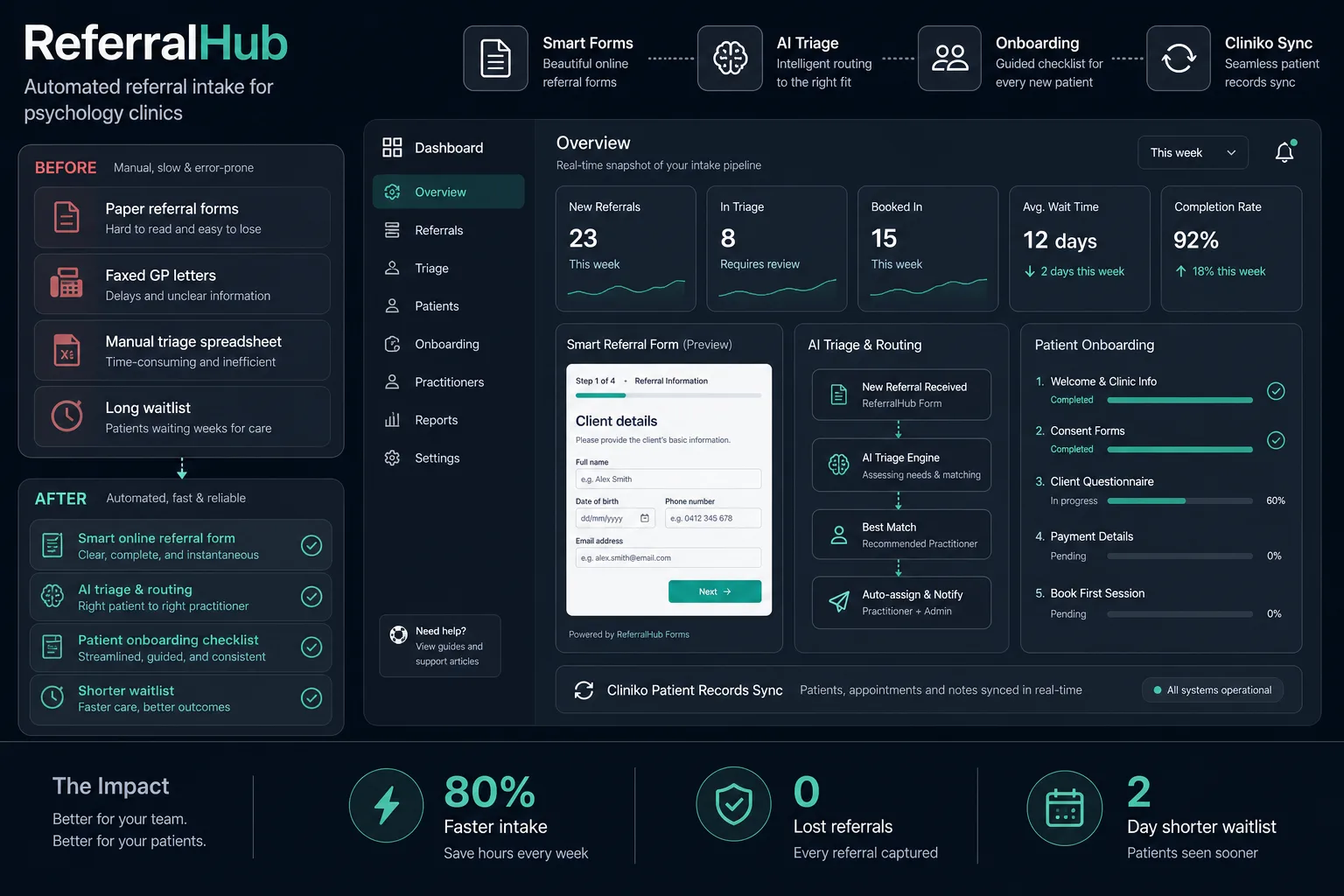
Referrals Arriving Faster Than Admin Could Process
The practice — eight psychologists across child, adolescent, and adult services in Sydney's inner west — had a reputation GPs trusted. That was the problem: referral volume outpaced intake capacity.
Intake coordinator Mia: "A GP would fax a referral on Monday. It sat in the inbox until Wednesday when someone had time to read it, create a Cliniko patient, figure out which psychologist handles adolescent anxiety, and call the family. Sometimes the fax got buried. Once we lost a crisis referral for four days — that kept me up at night."
The waitlist sat at 6.2 weeks average. Not because practitioners lacked capacity — because intake was the bottleneck.
Smart Referral Form Design
OceanSoft built a Snapforms-based referral form tailored for GP and self-referral pathways:
GP referral fields:
- Referrer name, provider number, practice details
- Patient demographics and Medicare number
- Presenting issue, urgency level, relevant history
- Preferred practitioner (optional) and session type (in-person / telehealth)
Self-referral fields:
- Simplified intake with mental health screening questions (K10-style, non-diagnostic)
- Consent and privacy acknowledgement
- Preferred contact method and availability
AI-assisted validation flags incomplete submissions before they reach admin: missing provider numbers, implausible dates of birth, or urgency marked "crisis" without emergency contact details.
Cliniko Integration Pipeline
Every submitted referral triggers an automated pipeline:
- Duplicate check — match against existing Cliniko patients by name + DOB + Medicare
- Record creation — new patient record with referral PDF attached to clinical notes
- Practitioner routing — AI triage suggests practitioner based on specialty tags, current caseload, and availability windows
- Admin review card — exception cases (new specialty request, crisis flag, duplicate ambiguity) appear in a review inbox
- Referrer acknowledgement — automated email to GP with referral receipt confirmation and estimated wait time
- Patient contact — SMS to patient within 2 hours with next steps and intake form link
Mia now starts her day in the review inbox — typically 3–5 cards requiring human judgement. The other 15–20 daily referrals flow straight through.
AI Triage Routing
Practitioner matching uses a rules engine with AI-assisted classification:
| Input | Routing logic |
|---|---|
| Presenting issue text | Classified to specialty tags (anxiety, trauma, child behavioural, etc.) |
| Patient age | Paediatric practitioners for under 16; adolescent specialists for 12–17 overlap zone |
| Urgency flag | Crisis → on-call practitioner SMS within 15 minutes; urgent → next available within 48 hrs |
| Telehealth preference | Filter to practitioners with telehealth-enabled Cliniko calendars |
| Caseload balance | Weighted round-robin among qualified practitioners |
Admin can override any routing suggestion with one click. The system learns from overrides over time.
Waitlist Transparency
Referrers and patients receive automated wait time estimates based on real Cliniko availability:
- GP acknowledgement email: "Estimated wait: 3–4 weeks for adolescent anxiety with Dr Chen"
- Patient SMS: "We've received your referral. First available appointment: [date]. Book now: [Cliniko link]"
- Weekly waitlist report to practice principal with specialty-level breakdown
Referrer satisfaction improved measurably — GPs report confidence that referrals are received and actioned.
Results After Six Months
| Metric | Before | After 6 months |
|---|---|---|
| Referral intake to first patient contact | 3.8 days | <4 hours |
| Referrals lost or delayed >5 days | ~2/month | 0 |
| Admin hours on intake data entry | ~15/week | ~3/week |
| Average waitlist (active) | 6.2 weeks | 4.1 weeks |
| GP referrer acknowledgement | Manual, inconsistent | 100% automated within 1 hour |
Practice principal Dr Nguyen: "We didn't hire more admin. We stopped doing work a form and an API call can do. Mia now matches complex cases to practitioners — that's work only a human should do."
Privacy and Clinical Safety
- All form data encrypted in transit and at rest; hosted on Australian-region infrastructure
- Crisis referrals bypass the standard queue — on-call practitioner receives SMS with patient contact details and GP notes
- Mental health screening responses stored in Cliniko clinical notes, not in the form vendor's database
- Full audit trail of referral receipt, routing decisions, and patient contact attempts
Engagement Model
Six-week delivery: form design and GP outreach collateral (weeks 1–2), Cliniko API integration and routing rules (weeks 3–4), AI triage tuning and admin training (weeks 5–6). Snapforms subscription and API hosting billed separately; integration layer owned by the practice.
Psychology and mental health practices on Cliniko can explore Software, AI & Automation from OceanSoft Solutions — or see our allied health Cliniko automation case study for a broader multi-clinic engagement.