When Cloud Storage Stops Scaling
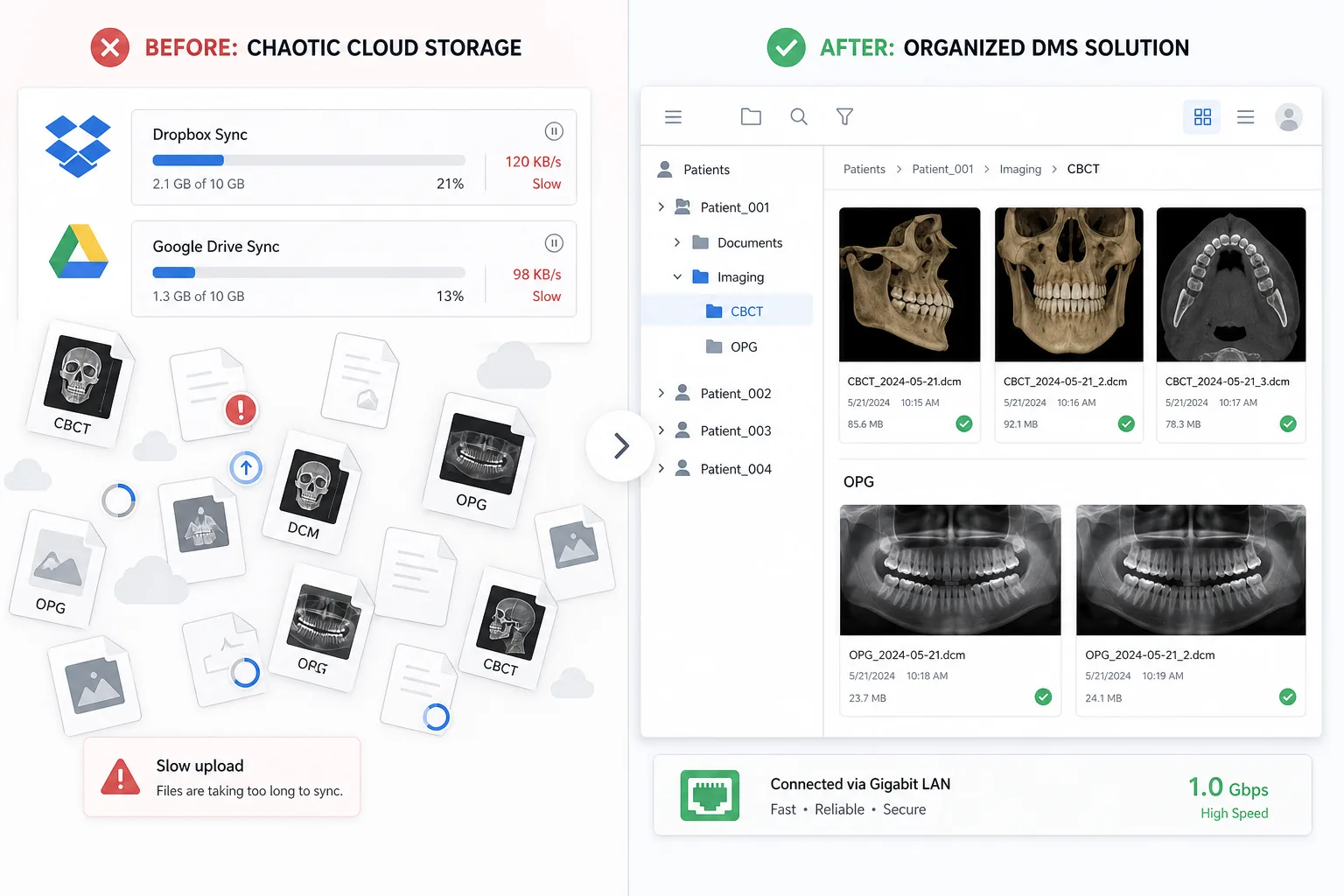
The clinic — a well-established Brisbane orthodontic practice with two treatment chairs and a growing referral base — had outgrown consumer cloud storage years earlier. Orthodontic workflows generate CBCT and OPG volumes that multiply with every new patient. Per-user cloud tiers and egress charges climbed faster than revenue, while asymmetric upload speeds meant clinicians waited on scans that should open instantly chairside.
Practice manager Emma described the daily friction: "Every CBCT upload to Dropbox took ten minutes on our connection. Chairside, the orthodontist would ask for yesterday's scan and someone would be watching a progress bar. We were paying for premium storage tiers and still hitting limits every quarter."
Lab partners received imaging via ad hoc email attachments with no consistent naming. Treatment coordinators maintained a spreadsheet of which scans lived where — cloud folder, local USB, or still on the imaging workstation. The system worked until it did not.
OpenDMS: Patient-Centric Imaging Library
OceanSoft deployed OpenDMS on a dedicated appliance on the clinic LAN — a document management platform designed around how dental teams actually organise patient records, not generic file sharing.
Folder structure:
- Patients →
{patient ID}→ Imaging/CBCT, Imaging/OPG, Treatment-Plans, Correspondence, Consent - Clinic → templates, compliance policies, staff credential records
- Lab-Partners → shared outbound imaging with external orthodontics labs
Key capabilities tuned for dental imaging:
- Local gigabit serving — files stay on NVMe; no internet round-trip for daily reads
- Check-in/check-out versioning — superseded treatment plans remain accessible but clearly marked; concurrent edits on shared documents avoided
- Metadata tagging — scan date, modality, and referring practitioner tagged at upload for fast search
- Automated offsite backup — encrypted cloud copy for disaster recovery only; primary workflow stays on-prem
Staff kept the familiar drag-and-drop experience without retraining on a new vendor portal. Admin retrained on one rule: every imaging file gets uploaded to OpenDMS with a patient tag, not emailed around.
Role-Based Access and Clinical Workflow
Access scopes aligned to clinical roles:
| Role | Access scope |
|---|---|
| Orthodontists | Full patient imaging and treatment plans for assigned cases |
| Treatment coordinators | Imaging upload, correspondence, consent — no financial folders |
| Admin | Clinic templates, compliance docs, lab partner shared folders |
| External lab partners | Read-only access to nominated patient imaging subfolders |
Treatment coordinators upload CBCT volumes directly from the imaging workstation to the patient's OpenDMS folder. Orthodontists open scans chairside over gigabit LAN — typically under two seconds for standard OPG files, under ten seconds for full CBCT volumes. No sync client polling a US-region data centre.
Lab partners receive a secure link to the relevant Lab-Partners/ subfolder rather than email attachments that bounce at size limits.
Privacy and Compliance
Patient imaging stays under the clinic's control on Australian hardware, supporting Australian Privacy Principles (APP) obligations and reducing third-party subprocessors in the data path. No US-region sync folders, no surprise storage overage invoices.
OpenDMS audit logging records who accessed which patient folder and when — supporting privacy impact assessments and insurer queries without reconstructing access from cloud vendor logs.
Results After Six Months
| Metric | Before | After 6 months |
|---|---|---|
| Monthly cloud storage subscription | ~$380 combined (Dropbox + Google Workspace) | $0 (primary workflow) |
| Average OPG open time chairside | 45–90 seconds (cloud sync) | <2 seconds (LAN) |
| CBCT upload to available-for-review | 8–12 minutes | <30 seconds (local ingest) |
| Storage overage incidents | 3 per year | 0 |
| Lab imaging delivery failures (size limits) | ~2 per month | 0 (secure folder links) |
Emma: "We stopped fighting our internet connection. The orthodontists open scans like they're on the same machine — because effectively they are. And I haven't had a storage overage email from Dropbox in six months."
What They Did Not Change
The clinic kept their existing imaging workstations and practice management software. OpenDMS became the imaging system of record — a dedicated document layer for CBCT, OPG, and treatment correspondence without replacing clinical systems. Lab partners continued using their existing portals; only the outbound imaging delivery path changed to secure folder links.
Engagement Model
Single delivery project over four weeks: OpenDMS server deployment and hardening, folder hierarchy configuration, migration of active patient imaging from cloud storage, staff training (half-day), and 30-day hypercare. No per-user SaaS licensing, no bloated MSP retainer — the clinic owns the infrastructure.
Clinics facing imaging storage sprawl can explore Managed Technology from OceanSoft Solutions — or see how we approached medical practice cybersecurity for another Brisbane healthcare engagement.