The Site-to-Office Gap
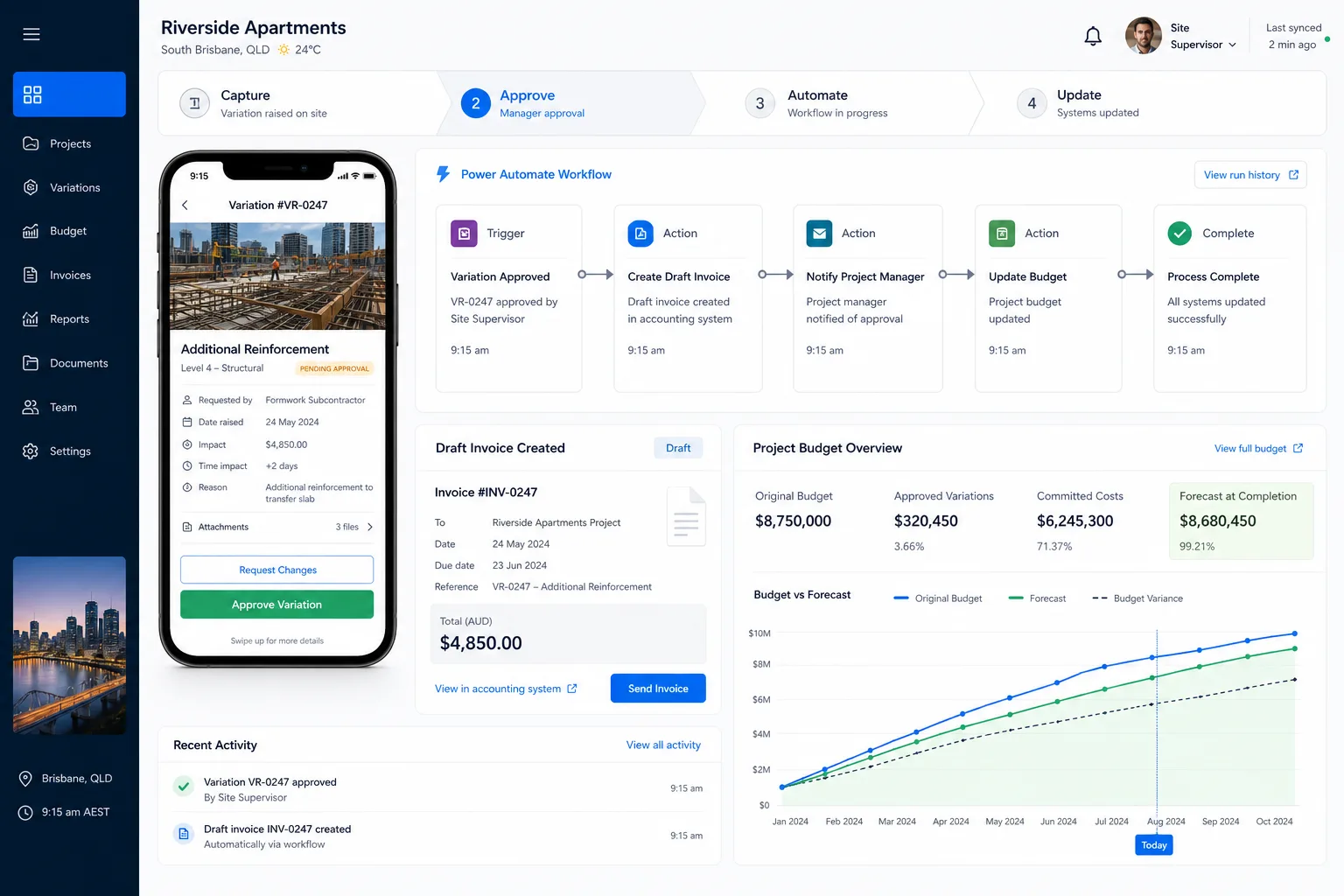
The builder — a well-regarded Brisbane firm running 25+ concurrent residential projects — had modernised field capture but not the handoff to finance. Supervisors were doing the right work on site — photos, dockets, variation approvals — but finance only saw it after admin re-keyed data into Xero and their project system.
Site supervisor Dave described the friction: "I'd approve a variation on my phone Friday afternoon. Admin wouldn't see it until Monday, then spend an hour figuring out the cost codes before creating a draft invoice. By then the client had already called asking where their bill was."
Variations sat in inboxes, budgets drifted unnoticed, and invoice runs slipped by days on every project. Month-end reconciliation surfaced margin erosion on jobs that were nearly complete — too late to recover.
Integration Flow
We connected the field platform to Xero with a Power Automate orchestration layer and Python micro-services for validation and mapping logic:
- Approved site dockets and variations trigger a webhook from field software
- Python normalises line items, cost codes, and GST treatment against business rules
- Power Automate creates draft Xero invoices and posts budget actuals to the project ledger
- Exceptions (missing PO, rate mismatch) route to a single admin queue — not full re-entry
Supervisors keep their existing mobile workflow; finance gets structured data the moment work is approved on site.
| Integration step | Input | Output |
|---|---|---|
| Webhook trigger | Approved docket or variation from field app | Raw JSON payload with line items |
| Python validation | Raw payload | Normalised line items, GST, cost codes |
| Xero draft invoice | Validated payload | Draft bill with correct contact and tracking category |
| Budget actuals | Validated payload | Committed cost posted to project ledger |
| Exception routing | Validation failure | Card in admin queue with original attachment |
Real-Time Budget Visibility
Project managers see committed and actual costs update when variations are signed off — not at month-end reconciliation. That closed the blind spot that had been letting margin erosion go unnoticed until jobs were nearly complete.
PMs now open a project dashboard showing committed vs actual by cost code. When a variation pushes a line item over budget, the alert fires at approval — not six weeks later at final account.
Dave: "I used to find out we were over budget when finance called me after month-end. Now I see it the same day I approve the variation. That's changed how I run my sites."
What They Did Not Change
Supervisors kept their existing field capture app and mobile workflow. Xero remained the accounting system of record. The integration layer connects approved site events to finance — no replacement of either platform, no change to how trades and supervisors work on site.
Why Document Management Was a Separate Problem
Field-to-Xero automation solved the transaction problem — capturing approved work from site into finance. It did not solve office document chaos: supplier invoices, plan libraries, and compliance files that finance and PMs struggled with daily.
The builder later engaged OceanSoft for OceanDMS document management — a complementary layer that made supplier invoices findable before automating the AP exception path.
Results After Six Months
| Metric | Before | After 6 months |
|---|---|---|
| Average invoicing cycle (approval to draft) | 6 days | 2 days |
| Double-handling of financial data | Every transaction | 0 (exceptions only) |
| Budget visibility lag | Month-end | Real-time at approval |
| Admin hours on docket re-keying per week | ~12 | ~2 (exceptions only) |
| Variation-related margin surprises per quarter | 3–4 | 1 |
Engagement Model
One architectural delivery: integration design, Power Automate and Python deployment, Xero mapping configuration, runbook, and handover. No retainer, no per-transaction SaaS middleware fees — the builder owns the integration and the Microsoft/Xero accounts it runs on.
Builders and trades with similar site-to-office friction can explore Software, AI & Automation — workflow automation, Xero integration, and Power Platform delivery without lock-in subscriptions.