A Brisbane project manager told us last month that finding the current plan revision for an active duplex took forty minutes — spread across three email threads, a WhatsApp group, and a shared drive folder named FINAL_v3_REALLY_FINAL. Finance had already automated invoicing. Site teams had mobile capture tools. Yet margin still leaked through the gap between documents that exist somewhere and documents someone can find right now.
That gap is not a filing problem. In 2026, it is a knowledge problem — and the builders closing it are treating document management as strategic infrastructure, not an admin afterthought.
The Hidden Cost of "Good Enough" File Storage
Most residential and commercial builders we speak with have already digitised. Invoices arrive by email. Plans come from architects as PDF attachments. SWMS documents live in Dropbox. Variations get photographed on site and forwarded to admin.
The stack looks modern. The experience does not.
Revision drift is the silent killer. When three trades work from different plan versions on the same job, rework is guaranteed — and rarely attributed back to document failure. Compliance gaps on active sites follow the same pattern: the SWMS exists, but nobody on site can prove which version is current without calling the office.
Industry analysts now describe enterprise content management as managing content across its full lifecycle — governance, automation, and insight generation — not passive storage. Builders who still treat shared drives as their DMS are paying for that gap in rework, delays, and audit exposure.
What Changed in 2026: Documents Become Knowledge Assets
Three shifts define the current document management landscape:
Intelligent Document Processing (IDP)
Incoming documents — supplier invoices, engineer certificates, council approvals — no longer sit as opaque PDFs waiting for manual sorting. Intelligent Document Processing extracts metadata at ingestion: vendor, project reference, document type, dates. Classification happens at the door, not in someone's inbox three days later.
Retrieval-Augmented Generation (RAG) Search
Keyword search across folder names fails when nobody named the folder consistently. Modern repositories support natural-language search grounded in your own content — ask "What is the latest structural engineer's certificate for 14 Riverside Drive?" and get an answer sourced from documents you actually uploaded, not a generic web result.
Audit-Ready Transparency
Regulators, insurers, and principal contractors increasingly expect traceable document lifecycles: who uploaded what, when it was superseded, and which version was active on a given date. Audit-ready transparency is becoming a competitive advantage, not just a compliance checkbox.
Hybrid Architecture: Control Where It Matters
A recurring concern among Queensland builders is data sovereignty. Project plans, client contracts, and financial records are not generic SaaS data — they are business-critical assets tied to specific jobs and relationships.
The emerging pattern is hybrid architecture: documents stay on infrastructure the builder controls — on-prem or dedicated tenant hosting — while orchestration and automation run in the cloud. You retain custody of project knowledge. Automation connects to accounting, email, and workflow tools without copying sensitive files into third-party silos.
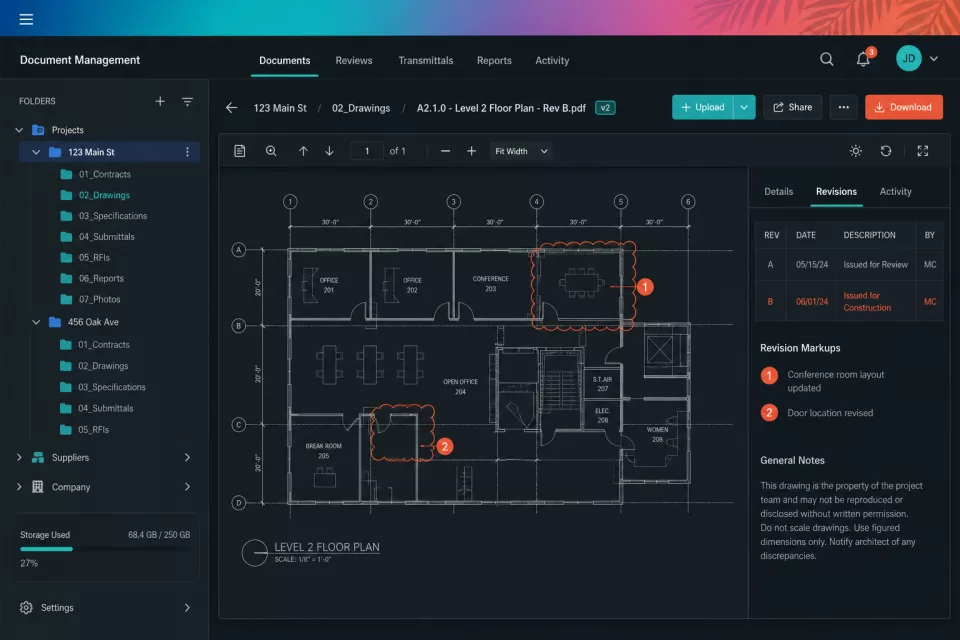
This is the model behind OceanDMS: a project-centric document repository with check-in/check-out versioning, structured folder hierarchies, and searchable archives — designed for builders who need control without sacrificing modern capabilities.
The Document Lifecycle Builders Actually Need
flowchart LR
    Ingest["Ingest & Classify\n(IDP at upload)"]
    Organise["Organise by Project\n(folders + tags)"]
    Version["Version Control\n(check-in / check-out)"]
    Search["Search & Retrieve\n(RAG + metadata)"]
    Audit["Audit & Govern\n(lifecycle trail)"]

    Ingest --> Organise --> Version --> Search --> Audit
Each stage serves a distinct purpose:
- Ingest — supplier PDFs, plan revisions, and variation approvals arrive tagged and classified, not dumped in a generic inbox
- Organise — project-centric hierarchy (Projects → job address → document type) mirrors how site teams think about work
- Version — check-in/check-out prevents two people editing the same SWMS simultaneously; superseded revisions stay accessible but clearly marked
- Search — admin, PMs, and compliance staff find the right document in seconds, not email archaeology
- Audit — every upload, edit, and supersede is attributable; ready for insurer or principal contractor review
Why Finance Automation Alone Is Not Enough
Many builders have already invested in Xero integrations, field capture apps, or Power Automate flows — and still lose hours to document retrieval. Finance automation solves the transaction problem. It does not solve the context problem: which variation approval supports this invoice, which plan revision the framer should be using, whether the current SWMS covers the work happening today.
Document management and financial automation are complementary layers. Builders who solve only one leave margin on the table in the other.
The Strategic Question
The question for 2026 is not whether to digitise — most builders already have. It is whether your document repository is a passive archive or an active knowledge platform that site teams, admin, and compliance can trust without a phone call to the office.
Builders moving to intelligent DMS report faster document retrieval, fewer revision disputes, and cleaner audit trails — without adding headcount. The technology exists. The gap is treating project paperwork as infrastructure worth investing in, not a problem to solve with another shared folder.
Explore how Managed Technology from OceanSoft Solutions helps Queensland builders deploy document management and workflow automation without vendor lock-in.