A Gold Coast accounting firm spent $180,000 on RPA bots over eighteen months. They automated twelve individual tasks — data extraction, form filling, report generation. Invoice processing still took four days. Customer onboarding still required manual handoffs between three systems. When a vendor updated their portal UI, two bots broke in the same week.
The ROI was negative. Not because automation failed — but because nobody orchestrated the end-to-end process.
This pattern repeats across Brisbane SMBs: construction AP teams, mortgage broker admin, professional services back offices. The industry has moved past asking whether automation works. The question now is why most programs fail to scale — and what agentic workflows with human-in-the-loop governance do differently.
The RPA Trap: Task Automation Without Process Intelligence
Traditional RPA excels at one thing: repeating a fixed sequence of UI interactions. Click here. Copy this field. Paste there. Submit.
The problems compound quickly:
- Brittle selectors — when a vendor updates their portal, bots break. Maintenance costs average $15,000 per bot per year in enterprise deployments.
- No exception handling — if step three fails, the entire process stops. There is no retry logic, no escalation, no visibility into where things stalled.
- Siloed tasks — one bot extracts invoice data, another validates it, a third posts to Xero — but nobody coordinates the handoffs.
Industry data suggests over half of RPA programs fail to scale beyond ten bots. The technology works for isolated tasks. It does not work for business processes that involve judgment, exceptions, and cross-system coordination.
Agentic Workflows: A Different Architecture
Agentic workflows take a fundamentally different approach. Instead of scripting UI clicks, they orchestrate event-driven processes across APIs and integrations — with AI-assisted reasoning for classification and routing, and explicit human checkpoints where judgment is required.
Key characteristics that distinguish agentic from traditional automation:
| Dimension | Traditional RPA | Agentic Workflows |
|---|---|---|
| Trigger | Scheduled or manual | Event-driven (new document, overdue invoice, expiry approaching) |
| Exception handling | Process stops | Routes to human-in-the-loop queue |
| Adaptability | Breaks on UI change | API-first; resilient to frontend updates |
| Governance | Opaque bot logs | Audit trail with approval history |
| ROI measurement | Tasks automated | Cycle time, error rate, admin hours saved |
The human-in-the-loop (HITL) model is critical. AI and automation handle high-frequency, rule-bounded work — classifying documents, matching invoices to projects, bucketing overdue receivables. Humans handle exceptions: ambiguous project codes, new vendors, compliance edge cases. This is not a weakness; it is governance that boards and regulators expect in 2026.
Straight-Through Processing vs Exception Queues
Leading implementations distinguish between straight-through processing (STP) — workflows that complete without human intervention — and exception queues where judgment is required.
Consider accounts payable in a construction company:
- STP path: Supplier invoice arrives, project code matches automatically, amount within tolerance → posted to Xero without review. Roughly half of invoices follow this path.
- Exception path: Invoice flagged — no project match, ambiguous code, new vendor → routed to a review inbox where a PM assigns the project and approves in two minutes.
The economic value is not automating 100% of tasks. It is automating the routine 50–70% while making the exception path fast and visible — not buried in email.
OceanFlow: Orchestration Without Complexity
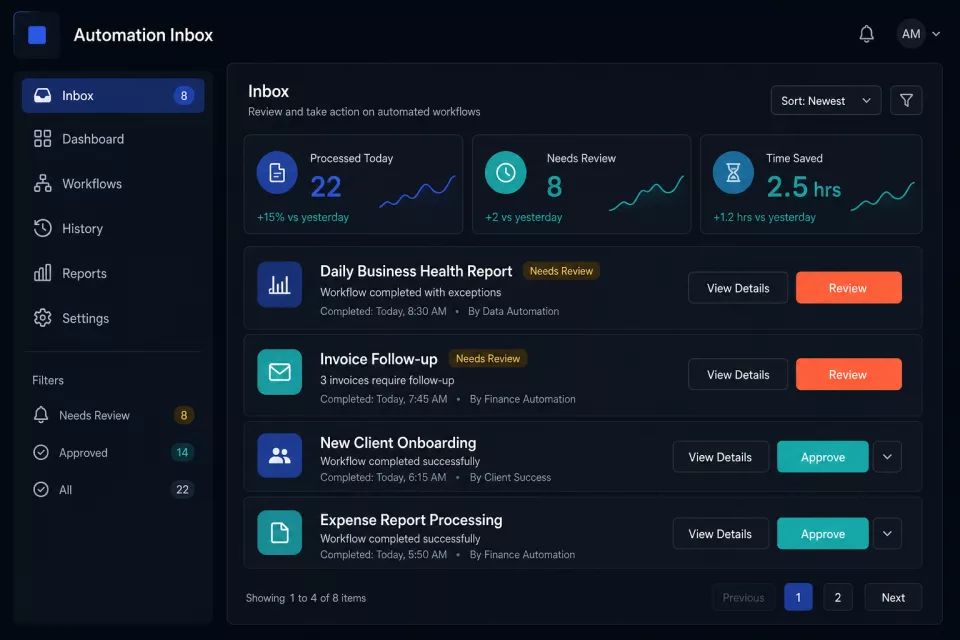
OceanFlow is built on this architecture. It provides pre-built workflow packs — configurable automation templates for construction AP, accounting health reports, mortgage document chase, and compliance alerts — delivered through guided wizards, not a raw workflow editor.
End users see:
- Automation inbox — pending approvals, flagged exceptions, processed items
- Workflow wizards — enable a pack, connect Xero or email, configure recipients
- Status and metrics — processed today, needs review, estimated time saved
They do not see the underlying orchestration engine. That abstraction matters: SMB admin staff are not automation engineers. They need outcomes, not node graphs.
Outcomes, Not Architecture
Two workflow packs illustrate the ROI model:
Daily Business Health Report — Every weekday morning, a consolidated snapshot of cash position, receivables, payables, and P&L arrives in the owner's inbox. No one opens Xero to check. Exceptions (failed API calls, missing data) trigger admin alerts, not silent failures.
Invoice Follow-up — Overdue receivables bucketed by age (7, 14, 30+ days) with urgency indicators. Internal summary email replaces manual spreadsheet review. Reminder history tracked to prevent duplicate chases.
These are not demos. They are production patterns deployed through OceanFlow's workflow catalog — configured per tenant, executed in the cloud, with documents and credentials staying under customer control.
Cross-Industry Patterns
The same agentic architecture serves different industries with different packs:
- Construction AP — invoice review inbox, project assignment, approve-and-post to Xero
- Mortgage broking — document checklist reminders for missing client paperwork; compliance expiry alerts before licenses lapse
- Professional services — daily financial health, client follow-up sequences, exception routing to partners
The orchestration layer is shared. The workflow packs and configuration are industry-specific. This is hybrid intelligence — not every decision requires the most powerful AI model; routine classification uses efficient processing, while complex exceptions escalate to humans with full context.
Measuring ROI That Boards Accept
Experimentation with AI and automation is over. Boards demand measurable outcomes:
- Cycle time compression — invoice processing from days to hours; document chase from manual email to automated reminders
- Error reduction — fewer mis-posted invoices, missed compliance deadlines, duplicate follow-ups
- Admin hours reclaimed — quantifiable time returned to billable or strategic work
Organisations implementing agentic workflows report 20–70% cycle time reductions and 10–40% cost reductions in document-heavy processes — with ROI visible within the first year when measurement focuses on operational KPIs, not technical novelty.
The Bottom Line
The builders, brokers, and professional services firms winning in 2026 are not chasing every new AI tool. They are investing in orchestration layers that connect existing systems — Xero, email, document repositories — with event-driven automation and human-in-the-loop governance.
Single-task bots belong in the graveyard. Agentic workflows with measurable ROI belong in production.
Ready to explore workflow automation for your business? Get in touch or learn about our Managed Technology services.